£35
Technical Problem Diagnosis
One stated problem + one video.
- What is actually wrong
- The underlying cause
- Additional problems I can see
- What should be done to correct it
Online technique diagnosis · Worldwide
Find the real cause of the problem — and know what to correct first.
One scale or a few bars can reveal far more than most pianists realise.
You describe what you think is wrong. I analyse what is actually happening in the playing, identify the underlying cause, point out any additional technical problems I can see, and tell you how to correct it.
What you notice
Tension · uneven notes · a passage that breaks down · something that simply doesn’t work
What I analyse
What is actually happening in the playing
Hand movement · finger function · wrist · coordination · posture · pedalling
What you get
The underlying cause + what to correct first
01 — The premise
What a pianist notices is often a symptom. The stiffness you feel in the right hand, the notes that will not run evenly, the passage that collapses at speed — these are results. The cause is frequently somewhere else entirely, and often earlier in the movement than anyone is looking.
So I do not simply confirm the problem you have described. I examine the playing itself, and I will tell you if what you sent me shows something different — or additional problems you have not noticed.
The hands are also not always where it ends. Where it is relevant I look at the whole playing mechanism — finger function, coordination between the hands, posture and alignment, and pedalling: the timing of pedal changes, over- or under-pedalling, and how the foot is working with the hands.
A description of the problem in your own words, and a short video. Nothing else. No grade, no level, no age, no history.
What the hands, fingers, wrists, arms and body are actually doing at the keyboard — and, where it is relevant, posture, coordination and pedalling.
What is actually wrong, the underlying cause, any additional technical problems I can see, and what should be done to correct it.
02 — Who this is for
Age, grade and level are not required for a diagnosis. What matters is what is visible in the playing.
03 — How it works
DescribeStep 1 of 6
Tell me what you think the problem is, in your own words.
Send the playing that is causing difficulty: a difficult passage, a persistent technical problem, pedalling, coordination, a performance excerpt — any section where something is not working. One scale or a few bars can be enough: sometimes very little playing reveals a great deal.
The whole process is asynchronous, so it works across any time zone. No consultation call required.
04 — Example diagnosis
The shape below shows how a submitted problem is taken apart. The corrective work itself is prescribed individually and is not published here.
Written to show the structure of a diagnosis. Not a real customer, case or testimonial.
“My 4th and 5th fingers become uneven when I increase the speed.”
The visible weakness is not necessarily an isolated 4th- and 5th-finger problem. The hand is beginning to compensate when those fingers are required to work.
The fingers are not consistently receiving and supporting the hand weight, so another part of the mechanism begins to assist.
Restore correct supported finger function and weight transfer before increasing speed.
A specific corrective exercise or programme is prescribed. Progress is then checked at increasing speeds, to make sure the correct movement remains present rather than disappearing under tempo.
Your diagnosis is individual. I may identify additional problems that you did not originally notice.
05 — Packages
Every package begins with the same full diagnosis. The difference is how many times I reassess the playing afterwards.
One stated problem + one video.
Initial diagnosis, then one reassessment.
Follow-up to be used within 6 weeks of the initial diagnosis.
Initial diagnosis, then two reassessments.
RecommendedFollow-ups to be used within 8 weeks of the initial diagnosis.
Initial diagnosis, then three reassessments.
Longest programmeFollow-ups to be used within 12 weeks of the initial diagnosis.
Separate service
For pianists wanting a broader analysis of a performance or difficult repertoire, including technical issues that may be affecting the performance.
All packages are delivered online, in English. Your initial diagnosis is normally returned within 3 working days, and follow-up assessments on the same timescale. Prices are in pounds sterling and are the same wherever you are in the world.
06 — Before you film
You do not need good equipment, a good piano or a good performance. You need the movement to be visible.
Frame the video so the hands, fingers, wrists, forearms and elbows are clearly visible, together with enough of the upper body to assess posture and alignment. Your face does not need to be in shot.
Angle the camera so the foot and pedal are in shot as well, or send a second short clip from that angle. Pedalling problems are invisible from above the keys.
It does not need to be a complete piece. The passage where the problem appears is the most useful thing you can send.
Do not slow it down to make it look better. I need to see the playing failing, not the playing behaving.
Cuts and retakes remove the evidence. A single unedited run of the passage tells me far more than a tidied-up version.
The sound matters as much as the picture. Put the phone near the instrument rather than filming from across the room.
If the video angle or quality does not allow me to make a proper assessment, I will ask you to reshoot it at no additional charge.
07 — Who is diagnosing
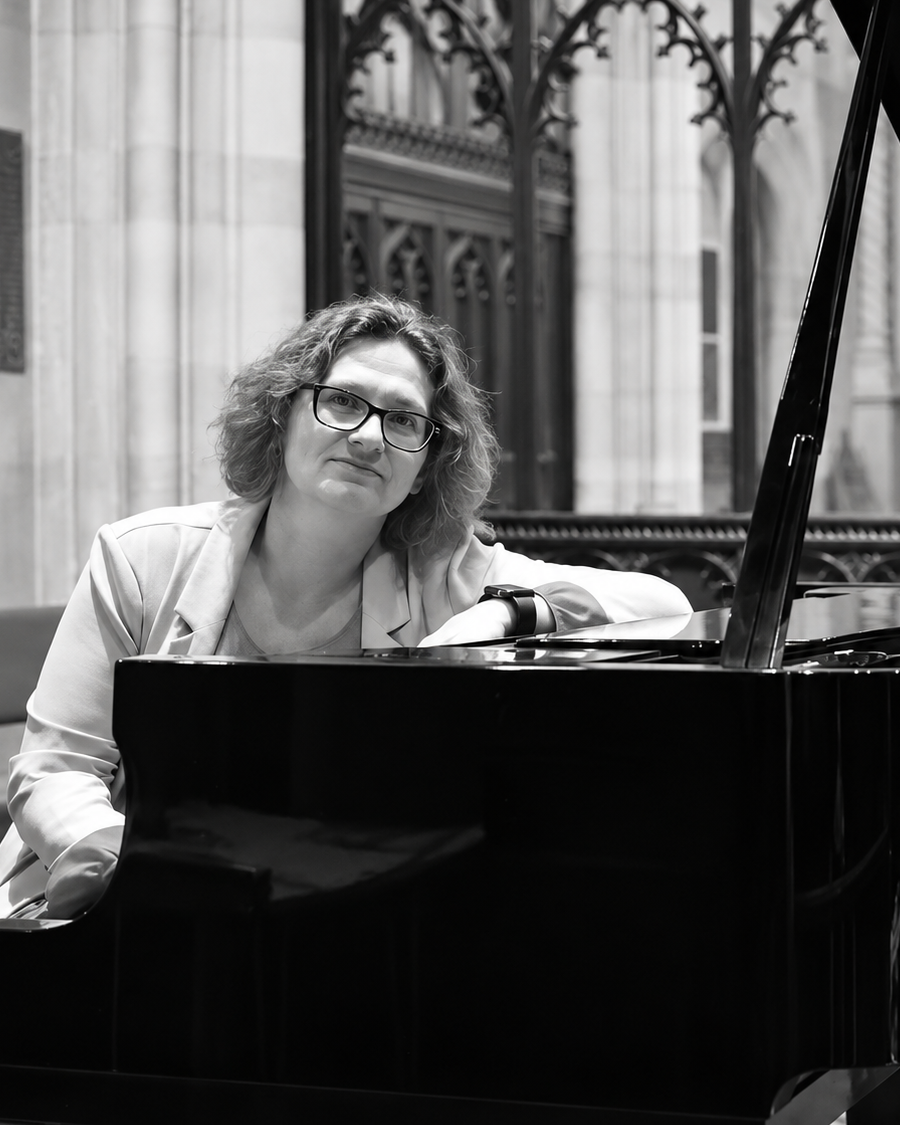
Edita StankeviciutePianist and piano pedagogue
Edita Stankeviciute is a pianist and piano pedagogue. She graduated with distinction from the Lithuanian State Conservatoire in Vilnius, taught piano at university level at the Vilnius Pedagogical Institute, and worked as a senior music specialist for the Department of Culture in Lithuania before founding Windsor Piano School in England in 2008.
More than thirty years of that career have been spent on technique itself: observing how pianists actually use their hands, identifying where a problem originates, recognising the compensations a player makes without realising it, and rebuilding faulty movement patterns so they hold under speed and pressure.
Her students’ results reflect that work. Windsor Piano School pianists have reached the BBC Young Musician Keyboard Category finals in both 2016 and 2020, and have won scholarships to schools including Eton College and St Paul’s.
Examination figures relate to Windsor Piano School, founded and directed by Edita Stankeviciute.
This service is not tuition. It is diagnosis — and the correction that follows from it.
08 — Submit your case
No grade. No level. No age. No teaching history.
If the video angle or quality does not allow me to make a proper assessment, I will ask you to reshoot it at no additional charge.
09 — Privacy & consent
Submissions are treated confidentially, and videos involving children are held to a stricter standard.
Your video and description are used solely to prepare the diagnosis and any follow-up assessments in your package.
No video is published, shared, shown to third parties, or used as a teaching or marketing example without your explicit written permission.
If the pianist is under 18, the submission must be made either by a parent or legal guardian, or by the child’s teacher with the parent or guardian’s permission, confirmed at the point of submission. Age, grade and level are still not required for the diagnosis itself.
Videos and case notes are retained only for as long as they are needed to deliver your package and follow-ups, and are deleted on request at any time.
Email to withdraw consent or request deletion, and the material is removed. Withdrawal after a diagnosis has been delivered does not affect the work already sent to you.
This is a technical assessment of piano playing. If you are in pain or have an injury, please also consult a qualified medical professional.